
Semikron Danfoss Innovation & Young Engineer Awards Winners 2026
Semikron Danfoss is proud to announce the winners of this year’s Innovation Award and Young Engineer Award, recognizing outstanding contributions to the advancement of power electronics.
Semikron Danfoss Innovation Award 2026
The jury has selected Neha Nain, Matthias Kasper, Kennith Leong, Gerald Deboy from Infineon Technologies Austria, together with Sven Weihe, Jonas Huber, and Johann W. Kolar from ETH Zurich, for their innovative work on ´Monolithic Bidirectional GaN Transistors – Power Electronics’ Missing Element´. (in the photo f.l.t.r: Peter Beckedahl, Prof. em Dr. Johann W. Kolar, Prof. Dr. Leo Lorenz)
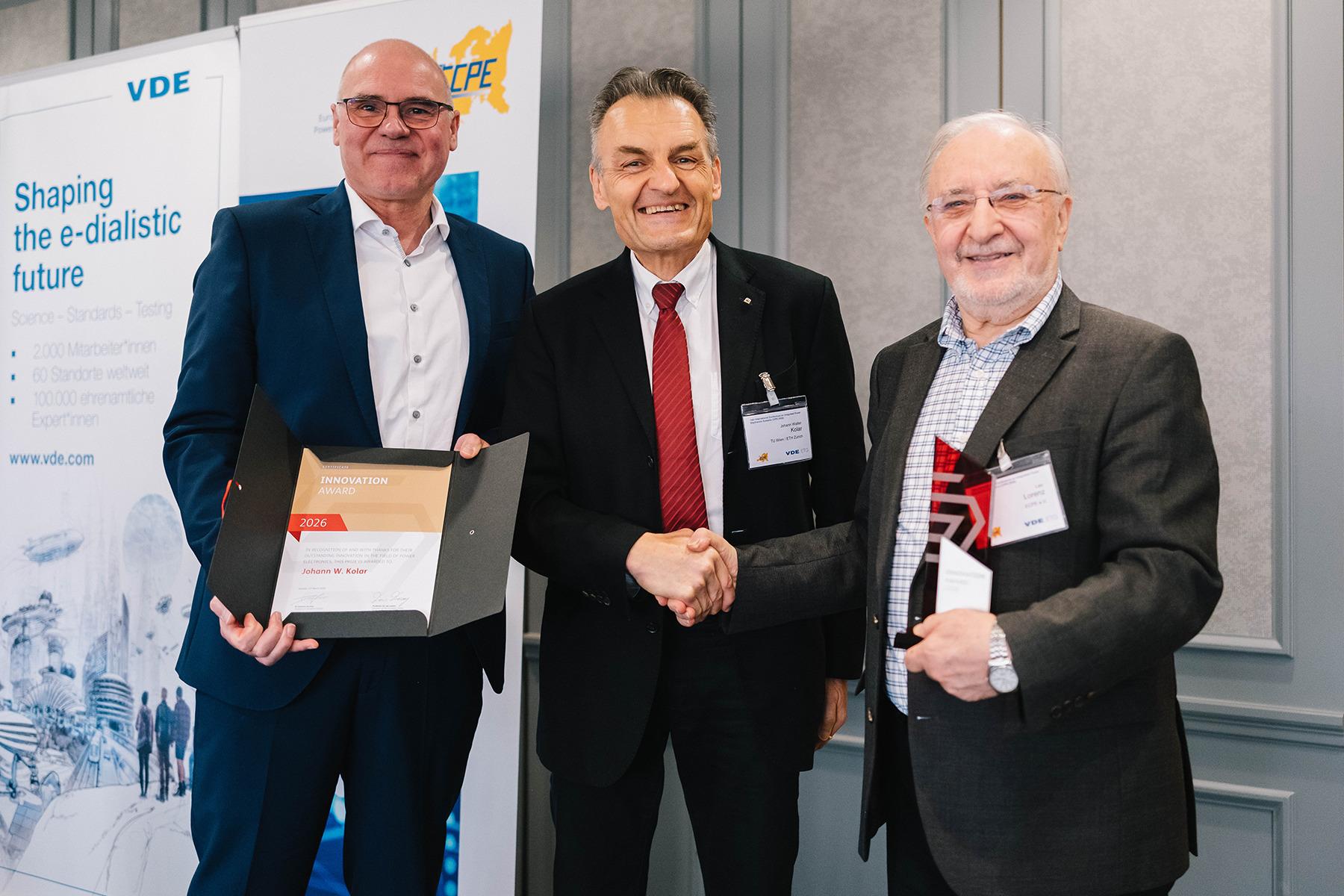
Their innovation introduces a new class of high-voltage GaN monolithic bidirectional switches (MBDS) that opens the door to novel application spaces - particularly single-stage converter topologies. MBDSs devices provide true four-quadrant operation via a common-drain, double-gate architecture, replacing back-to-back transistor pairs and thus reducing semiconductor chip area to one quarter at equal conduction loss. They also add versatile operating modes, including a new single-gate self‑reverse‑blocking hybrid, simplifying drive and protection.
At the system level, MBDSs unlock compact, efficient current-source, matrix, Vienna-type, T-Type, and HERIC converters, and facilitate new single-stage, isolated ac-dc topologies. One example is the Indirect Matrix‑Type LLC (IMLLC) rectifier, achieving unity power factor with only 10 transistors and targeting 15 kW/dm3 power density. Another example is the new phase‑modular X‑Rectifier for EV on-board chargers (OBCs), which supports bidirectional power exchange with three-/single‑phase grids without derating, a wide battery voltage range, and a flat form factor, using 650 V GaN MBDSs for a 400 V mains.
These new MBDS-based topologies can significantly reduce device count and ratings, eliminate dc‑bus capacitors, shrink magnetics, and boost efficiency, reliability, and sustainability.
GaN-based MBDS technology also significantly simplifies established circuit topologies and paves the way for CIS (constant current source) motor drive inverters, reducing current ripple, losses, acoustic noise, and improving overall system performance. It´s a very promising direction for the future development of power electronics.
Congratulations to the team for this exceptional achievement.
Semikron Danfoss Young Engineer Award 2026
This year, the Young Engineer Award is shared equally between two outstanding researchers.
We are honoring Ruben Schnitzler from the University of Stuttgart, Institute of Robust Power Semiconductor Systems, Germany for his work on ´Rapid Gate Switching Instability Characterization of SiC MOSFET at Extended Lifetimes using Accelerated Switching Frequencies of 40 MHz´. (in the photo f.l.t.r: Peter Beckedahl, Ruben Schnitzler, Prof. Dr. Leo Lorenz)
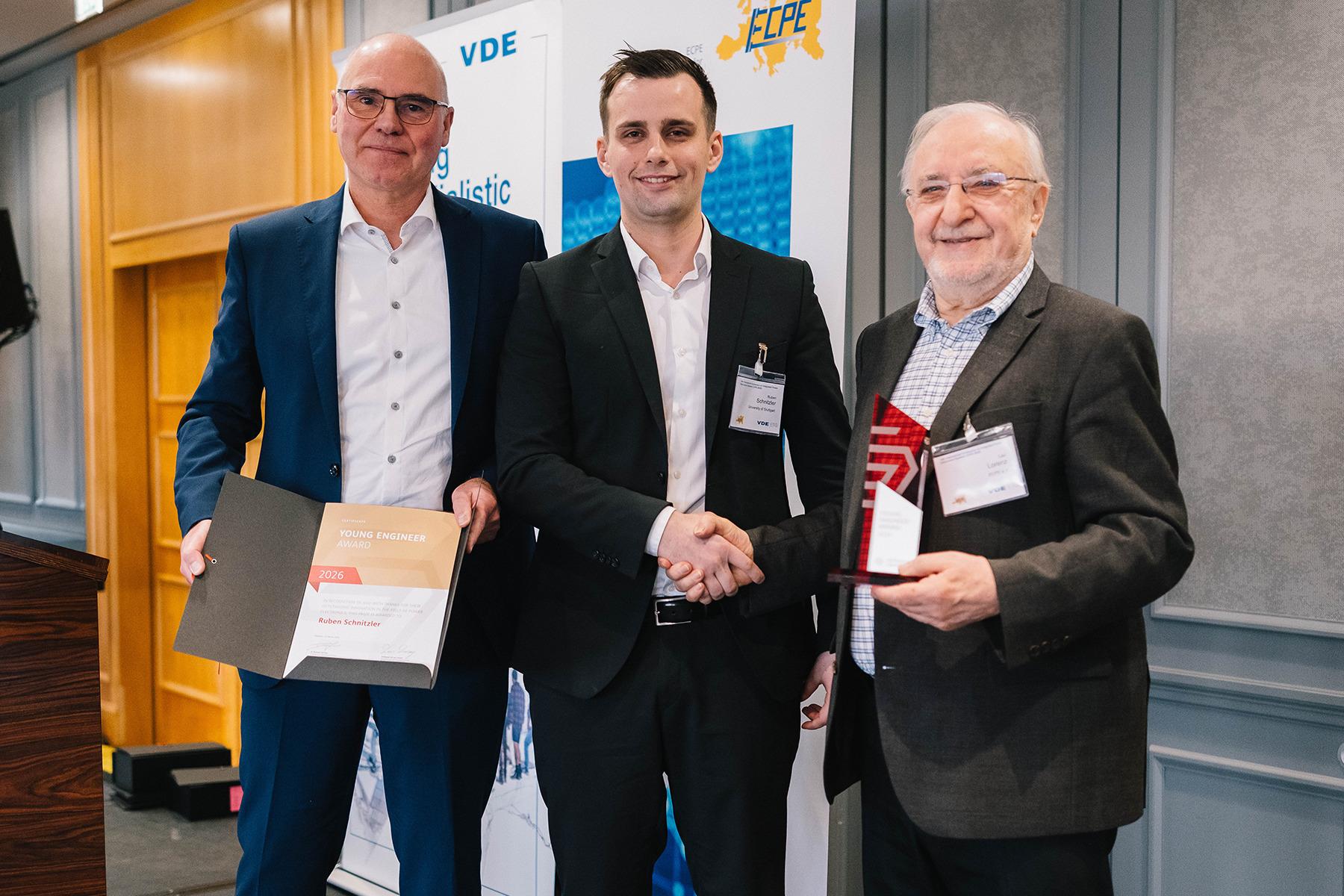
Silicon Carbide (SiC) MOSFETs offer substantial efficiency and power density benefits, but reliability remains a key challenge for this technology. Ruben Schnitzler`s research focuses on gate-switching instability caused by repeated bipolar switching, which degrades the threshold voltage and reduces efficiency over the lifetime of a SiC MOSFET.
His work introduces 40 MHz accelerated gate-switching stress tests, validating their linear acceleration factor and enabling commercial qualification methods up to 80x faster than current industrial standards. The study also analyzes key challenges tied to high-frequency stress testing. The results show that not only gate-switching instability-related trapping, but also detrapping can be observed beyond 1012 switching cycles.
With the highly accelerated switching frequencies, it is shown that also this phenomenon is rather cycle-dependent than time-dependent and highly influenced by the positive gate-source voltage. Furthermore, it is shown that a simple saturation or reversal model is insufficient to describe gate switching instability at extended lifetime due to a third effect of retrapping occurring beyond 3⋅1012 switching cycles for some gate-source voltages.
This work concludes that an extrapolation at 3⋅1011 and even at 3⋅1012 switching cycles may yield a wrong approximation of the observed degradation in operation, which is not possible within commercial gate switching stress test systems, due to large measurement times of several 100 days. This work proposes a solution to this uncertainty by enabling characterization of gate switching instability at highly accelerated 40 MHz, which equates to 1014 switching cycles within 30 days, sufficient for all applications with 120.000 operating hours, even at a switching frequency of 250 kHz. Sensing parameters for lifetime extension of power semiconductor devices is key in all applications.
This deep investigation enhances understanding of degradation mechanisms in SiC transistors and contributes valuable insights for lifetime extension.
Congratulations on this pioneering work.
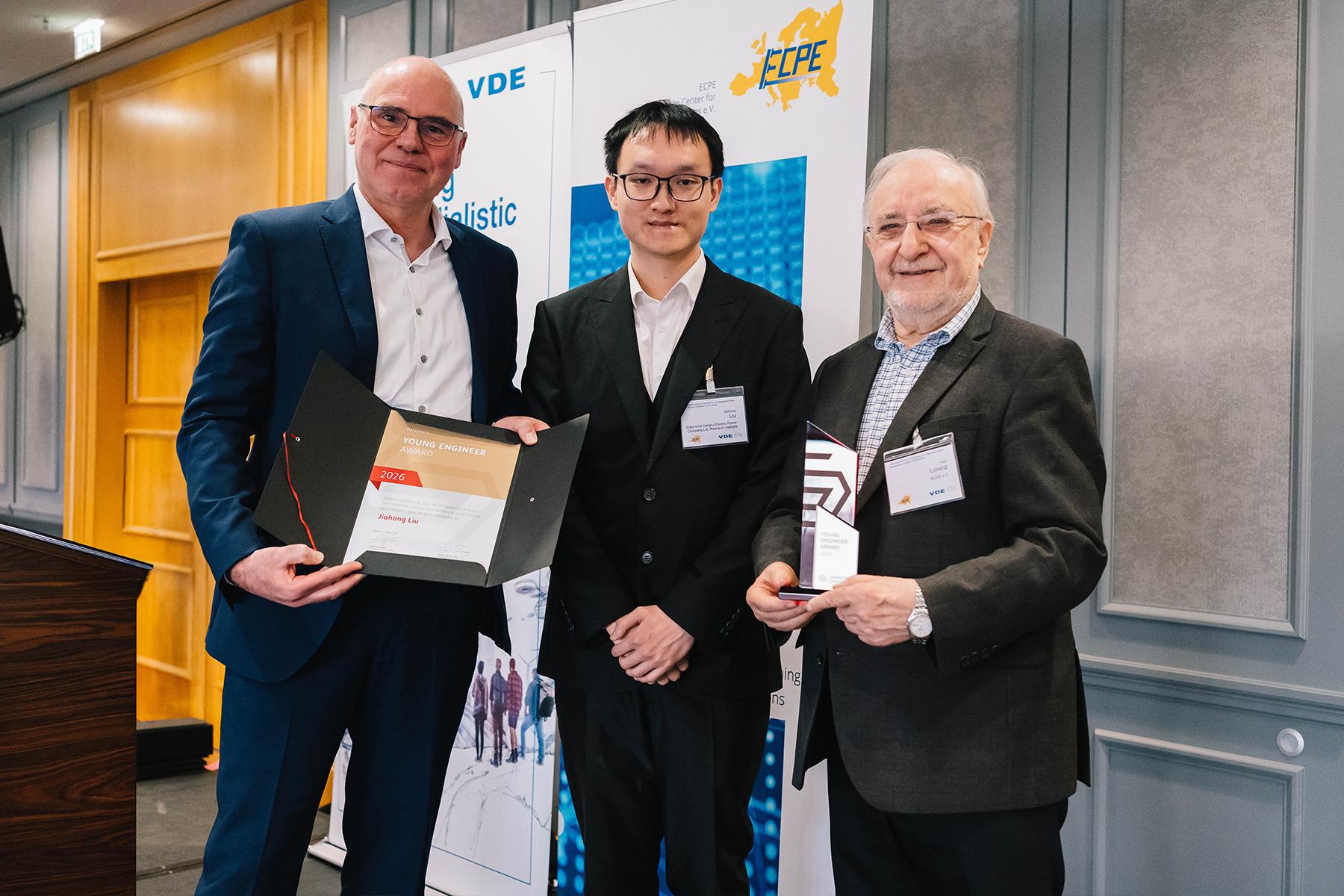
We also honor Jiahong Liu from the Aalborg University, Department of Energy, Denmark for his work on ´A Practical Gate-Driver Add-on for SiC MOSFET Reliability: Ultrafast Adaptive Short-Circuit Protection and Online Gate-Oxide Health Monitoring´.
This work presents two highly practical gate-driver-level innovations aimed at improving SiC MOSFET reliability in high-performance power converters. (in the photo f.l.t.r: Peter Beckedahl, Jiahong Liu, Prof. Dr. Leo Lorenz)
1. Adaptive short-circuit protection
The first innovation is an adaptive current threshold concept for rapid and robust short-circuit protection, which dynamically sets the protection threshold according to the load current to avoid the speed–robustness trade-off of conventional fixed-threshold strategies.
2. Online gate-oxy health monitoring
The second innovation is an online gate oxide degradation monitoring method based on turn-on gate voltage filtering, which extracts a degradation-sensitive health indicator by a simple analog bandpass filter and a peak detector with a low sampling frequency requirement. The experimental verification is convincingly presented for both innovations.
The short-circuit protection method is validated by 450 V multi-pulse tests and converter-level operation, demonstrating a detection time down to 66 ns. The gate oxide monitoring method is verified by multiple high-temperature gate bias aging tests and by experiments in a double pulse tester and a three-phase inverter under dynamic operation, showing a clear and robust indicator shift with good noise immunity.
Short circuit detection and reliable turn off performance of fast switching power semiconductor devices is a challenge for designing an active Gate Driver. Adding on an online gate oxide health monitoring for avoiding degradation effects is an impressive step towards field reliability.
Congratulations on this pioneering work.
About the Semikron Danfoss Innovation & Young Engineer Awards
Established in 2012 by the SEMIKRON Foundation in cooperation with ECPE, the awards aim to inspire individuals and organizations to pursue groundbreaking developments in power electronics - a key technology for improving environmental protection, resource efficiency, and sustainability.
Following years of successful collaboration, this tradition continues under the Semikron Danfoss name after the 2022 merger of SEMIKRON and Danfoss Silicon Power.
Contact:
Jakob Stroem
Head of Communications
Phone: +49 170 105 3294
E-mail: communications@semikron-danfoss.com